Implemented Lab
AI Model Console
A full-stack architecture lab for model request workflows, request history, and usage visibility.
Summary
Status
Implemented
Stack
Next.js, TypeScript, React Query, FastAPI, Pydantic
Focus
Model request workflows, server state, API contracts
Access
Internal demo
Overview
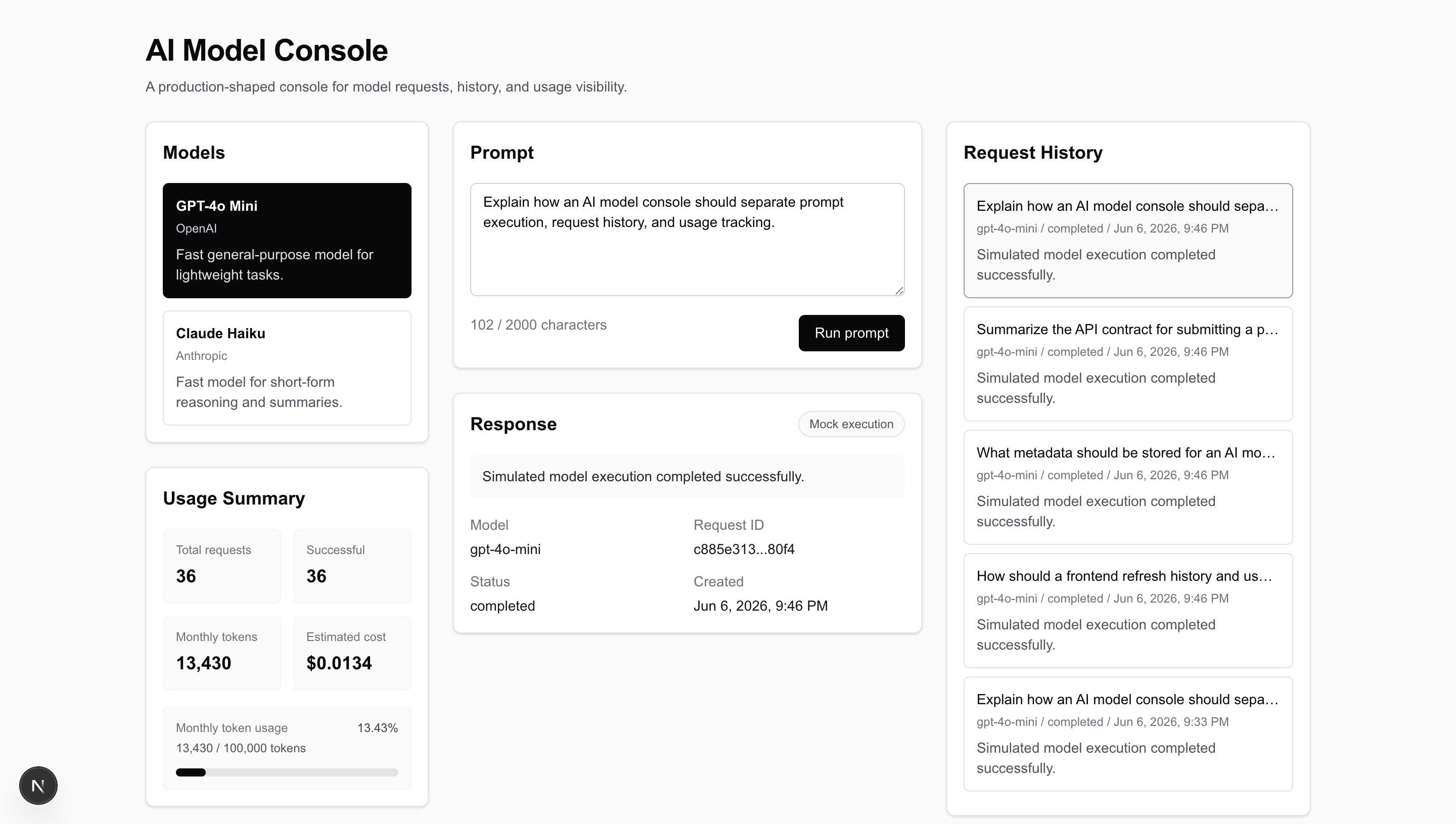
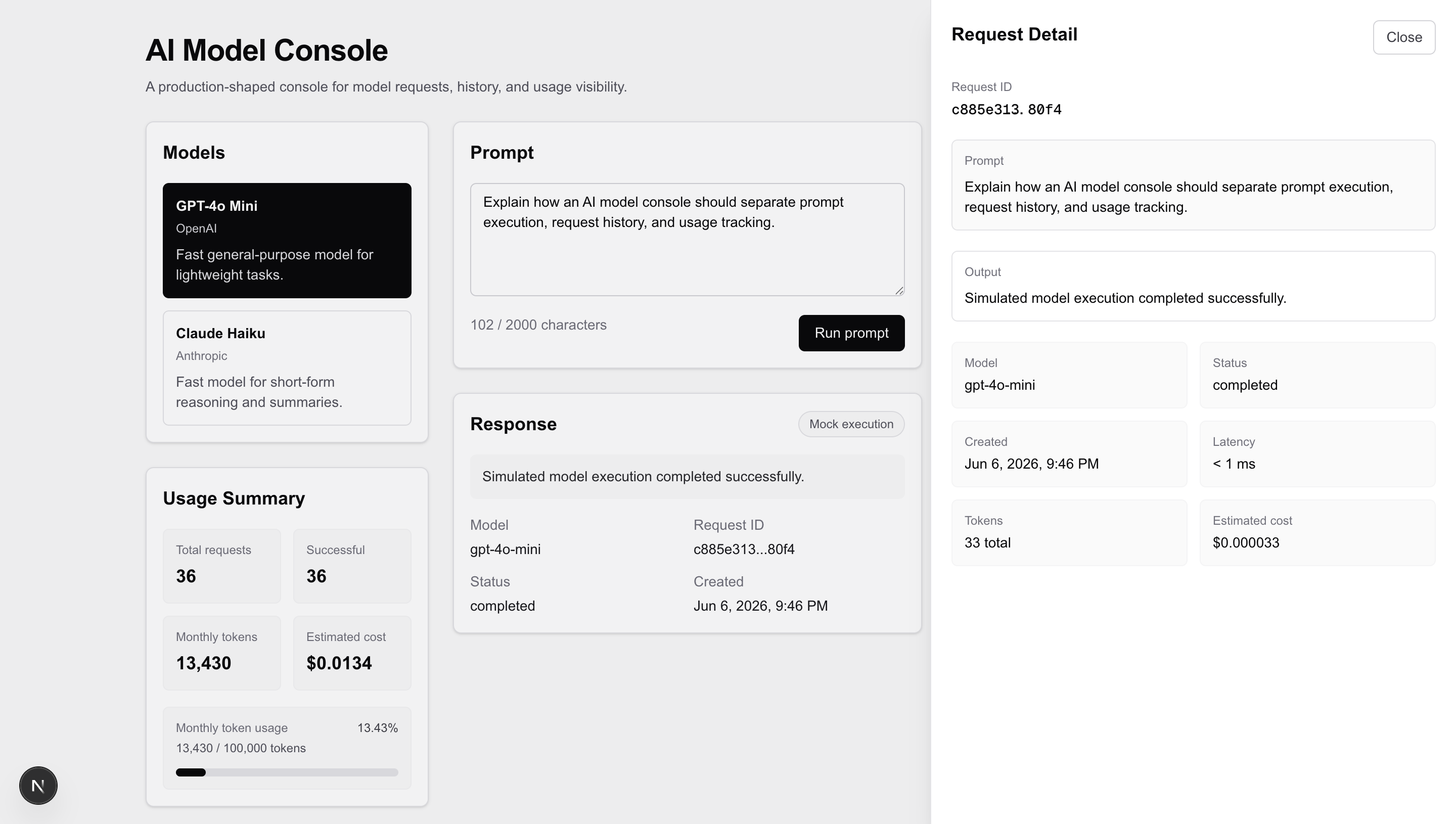
AI Model Console focuses on the product system around model calls: model selection, prompt execution, request metadata, history, usage summary, and API contracts.
Architecture highlights
- React Query manages server-owned data such as models, request history, request detail, and usage summary.
- Page components compose feature hooks instead of calling API functions directly.
- Prompt submission is modeled as a mutation that invalidates history and usage queries.
State ownership
Server-owned data
Models, request history, request detail, and usage summary.
Client UI state
Selected model, prompt draft, active request id, and drawer open/closed state.
Backend-owned derived data
Request status, latency, token estimates, estimated cost, and usage summary.
Mutation invalidation
Prompt submission invalidates history and usage summary instead of duplicating local state.
Screenshots
Server-state update
Prompt submission is a mutation. After success, related server-state queries are invalidated instead of manually syncing duplicated local state.
onSuccess: () => {
  queryClient.invalidateQueries({ queryKey: ['history'] });
  queryClient.invalidateQueries({ queryKey: ['usageSummary'] });
}
Trade-offs
- Mock execution instead of real model calls, so the lab can focus on request lifecycle and API contracts.
- React Query instead of Redux or thunk logic, because the main complexity is server-owned data.
- No global client store was added because the remaining client state is local and small.